

 Secure Shipping

 Worldwide express delivery
 Secure Payment
How does a wastegate work on a turbocharger

Introduction
TL;DR: A wastegate controls turbo speed by bypassing exhaust around the turbine. It prevents overboost, protects the engine, and stabilizes drivability. Types: internal (compact, OE) and external (precise, performance). Common issues: boost creep, flutter, and actuators that stick open/closed. Diagnose with a vacuum/pressure test of the actuator and logs of commanded vs actual boost.
In the fast-paced world of automotive engineering, understanding every bit of machinery is vital for enthusiasts and professionals alike. One such component that often piques curiosity is the wastegate in a turbocharger. At its core, a wastegate regulates boost pressure so the turbo doesn’t overspeed. But how does it manage that? Let’s dive in.
How Does a Wastegate Work on a Turbocharger?
Turbochargers are synonymous with enhanced performance, but they need controlled turbine speed. The wastegate is a bypass valve on the exhaust side. By opening to route some exhaust around the turbine, it limits turbo speed and thus the boost delivered to the engine.
Functionality of the Wastegate
The primary role is to prevent excessive boost (and damaging cylinder pressures/temps). It achieves this by opening a passage that lets part of the exhaust flow skip the turbine, capping shaft speed and boost.
Importance in Engine Performance
Without effective control, overboost can trigger knock, limp mode, or mechanical damage. With a well-set wastegate strategy, boost ramps smoothly, throttle response improves, and reliability is protected.
Mechanism Behind the Scenes
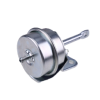
Most systems use a pneumatic actuator and a control solenoid (e.g., N75). Crack pressure (spring setting) defines base boost; the ECU modulates the solenoid’s duty cycle to bleed or apply pressure to the actuator, precisely positioning the wastegate. Modern setups may use an electronic wastegate actuator (DC motor + position sensor) for faster, closed-loop control.
Different Types of Wastegates
Internal Wastegates
Integrated into the turbo’s turbine housing with a flapper-style valve. Common on factory turbo vehicles for packaging, cost, and emissions integration.
External Wastegates
Standalone valve mounted on the manifold or header. Favored in high-performance applications for better flow and boost control authority, especially at high exhaust mass flow (reduces boost creep).
| Type | Pros | Cons | Best for |
|---|---|---|---|
| Internal (IWG) | Compact, cost-effective, OE integration | Limited valve size/flow; prone to creep at high power | Stock to mild builds |
| External (EWG) | High flow, precise control, flexible placement | More plumbing/space; higher cost | Track/drag and high-boost builds |
Evolution Over the Years
Wastegates evolved from simple pneumatic poppets to ECU-controlled systems with position feedback, boost-by-gear, and refined PID control for responsiveness and emissions. Electronic actuators are increasingly common for accuracy and faster corrections.
Historical Perspective
Early wastegates were mechanical only. As power density and emissions demands grew, precise closed-loop boost control became standard.
Modern-day Innovations
Modern engines use electronic wastegates, gear/temperature-based boost limits, and strategies that coordinate with throttle and cam timing to reduce lag and improve drivability.
Potential Issues and Solutions
Even robust systems need correct sizing and calibration.
Boost Creep
Occurs when exhaust flow exceeds wastegate bypass capacity, causing boost to rise with RPM despite the valve being open. Fixes: larger valve, better wastegate placement, or porting the turbine/wastegate passage.
Wastegate Flutter
Rapid valve cycling from control oscillations, marginal spring pressure, or plumbing layout. Solutions: correct spring rate, refine solenoid control/PID, shorten hoses, add a small restrictor if specified by the manufacturer. Note: don’t confuse with compressor surge.
Quick Diagnosis & Setup
- Scan & log: record commanded vs actual boost, wastegate duty/position, throttle, MAP. Check codes (overboost/underboost).
- Actuator test: apply vacuum/pressure with a hand pump. Confirm crack pressure and smooth travel; check that it holds.
- Mechanical checks: verify linkage alignment, flapper seating (IWG), seat condition (EWG), and free motion when hot.
- Plumbing & solenoid: route lines per spec; avoid long runs and tees that add delay. Replace brittle hoses.
- Calibration: set base boost (spring/crack pressure), then tune duty tables. For EWG, confirm sensor calibration and end-stops.
FAQs
What is the primary purpose of a wastegate in a turbocharger?
To regulate boost by bypassing exhaust around the turbine, preventing overspeed/overboost and protecting the engine.
Is there a difference between an internal and external wastegate?
Yes. Internal is integrated and compact; external is standalone with more flow and precision for high-power setups.
How has the wastegate design evolved over the years?
From mechanical actuators to ECU-controlled electronic units with position feedback and advanced boost strategies.
Can wastegates face issues?
Yes. Boost creep, flutter, and sticking valves are common. Address sizing, placement, spring rate, and control calibration.
Why is it essential to maintain wastegate functionality?
A malfunctioning wastegate can cause overboost, knock, or limp mode. Proper function ensures reliability and consistent power.
Are wastegates exclusive to turbochargers?
They’re chiefly part of turbo systems, but similar bypass/control concepts exist in other pressurized systems.
Conclusion
Understanding how a wastegate works reveals why this small valve has an outsized impact on power, safety, and drivability. With the right type, sizing, and calibration, your turbo setup delivers reliable performance every day.